
Building Strong English Skills for a Brighter Future
Welcome to English on the Run.
We are an online English school that believes in creating unstoppable individuals who fearlessly express themselves in English, creating the way for endless possibility.

English for ADULTS
Elevate your global communication skills. Transform your English from uncertainty to fluency.

English for KIDS & TEENS
Empower your child to become a confident global citizen with our unique international conversation groups and global community.

Study English Abroad
Open up your perspectives take a step into a future with summer study programmes abroad.

Don't sign up for any business English course before doing this!
Understand where you need to focus your efforts and save your time with this ultimate 10-step guide and planner.
About Audrey, the founder of English on the Run
Hi, I'm Audrey Smith, the driving force behind English on the Run.
In 2018, I embarked on this journey with a clear vision: to revolutionize language learning through flexible and innovative approaches.
My inspiration come from my own personal experiences – I grew up in Australia but as an adult I moved to Italy, and now Palma, Spain. I know the challenges of overcoming language barriers firsthand. Navigating a foreign culture, I've felt the familiar pang of nervousness about speaking another language.
It's this empathy that guides my commitment to guide you towards unlocking your true potential in English.


Master English at Family Dinners Abroad
English Learning, Family Travel, Conversation Skills
These 3 Questions Will Help You Survive Family Dinners in English!
Visiting your adult children abroad should feel warm and joyful, not like a stressful English exam. Let’s turn those fast, noisy family dinners into moments where you can relax, connect, and show your real personality—without needing “perfect” grammar.
Feel Confident at the Dinner Table
Simple English questions that help you connect with family
That Silent, Awkward Feeling at the Table
Imagine you’ve just flown overseas to visit your adult children. You’re in Stockholm, New York, or maybe London. You’re sitting around a big dinner table with their partner’s family. Everyone is laughing, passing dishes, and speaking fast in English. You want to join in, make a joke, or compliment the food… you open your mouth, but the right moment never seems to appear.
So you smile quietly, nod along, and hope nobody notices how lost you feel. Inside, you might feel a little left behind, a bit frustrated, and maybe even a bit invisible. I promise you: this social “bug” is not in you. It’s in the way we were taught languages.
💬 Gentle reminder: You are not bad at English. You were just never given the right tools for real-life, noisy family dinners.
Why Traditional English Classes Don’t Prepare You for This
Traditional academies and language apps are great at teaching you how to pass exams, order a coffee, or book a hotel room. But they almost never teach you how to survive a fast, overlapping conversation with ten people talking at once, background music playing, and someone asking you to pass the salad in the middle of a joke you didn’t understand.
I think of it like this: most courses give you the “theory documentation,” but not the real-world use cases. At a family dinner, you don’t need advanced vocabulary. You need a few reliable “functions” you can call again and again to start warm, simple conversations.
Watch the Full Video for Extra Support
I made a video walking through these ideas step by step, with examples you can listen to and repeat. You can watch it here:
Watch the full video on YouTube
3 Simple Icebreaker Questions for Family Dinners
Let’s treat your English like a small, friendly program. You don’t need hundreds of features. You just need a few reliable “functions” you can reuse in different situations. Here are three that work beautifully at family dinners and have been tested many times at parties and dinners in Italy and Spain.
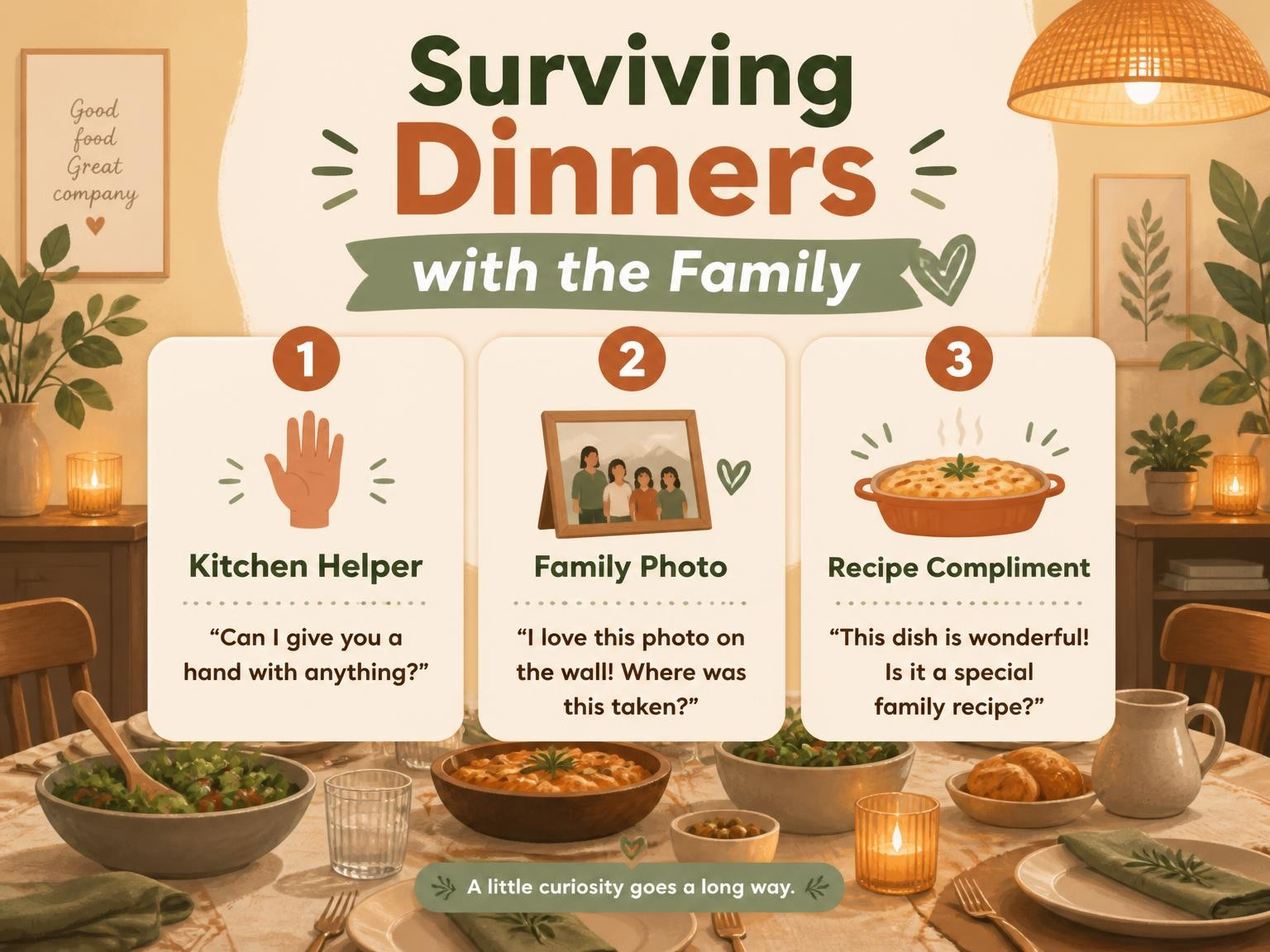
1. The Kitchen Helper: “Can I give you a hand with anything?”
Big group conversations can feel like a noisy production server: too many requests at once, hard to follow, and you’re not sure where to start. The kitchen is your quiet “debugging” environment. When you walk into the kitchen and gently ask, “Can I give you a hand with anything?”, several good things happen at the same time:
Your speaking anxiety drops, because you’re focusing on helping, not on “perfect English”.
You get a calm, one‑to‑one moment with the host or a family member.
You show that you are kind, thoughtful, and part of the team, even with simple language.
If the sentence feels long, you can shorten it to: Need any help? The meaning is the same, and the warmth is still there.
2. The Family Photo Question: “I love this photo on the wall! Where was this taken?”
Photos are like friendly user interfaces: they invite stories without needing complex input from you. When you point to a picture and say, “I love this photo on the wall! Where was this taken?”, you’re doing something very powerful and very simple:
You give the other person a chance to talk about a happy memory.
You only need to listen, smile, and react with short phrases like “Wow!”, “That’s beautiful!”, or “So nice!”.
You show real interest in their family, not just in the language.
The question does the heavy lifting. Your job is just to stay curious and relaxed, the way you might step through logs when you’re reading a system’s history.
3. The Recipe Compliment: “This dish is wonderful! Is it a special family recipe?”
Food is the universal programming language of families. When you look at the host and say, “This dish is wonderful! Is it a special family recipe?”, you open a warm, easy topic that almost everyone at the table can join in on.
People love talking about how they cook, who taught them, and what they eat on holidays.
You don’t need long replies. Short reactions like “I’d love to try it at home” or “My mother makes something similar” are more than enough.
You show respect and appreciation for their culture and effort.
💡 Soft skill from software to dinner table: Just like good code reviews start with something positive, good conversations often start with a kind compliment.
The Number One Trick: Keep Asking Questions
Even with these three questions, you might still miss parts of the conversation. That’s okay. At big dinners, even native speakers miss jokes or stories. The number one trick is simple: keep asking gentle questions. People love to talk about themselves, their memories, and their food. When they talk more, you feel less pressure to perform and more space to just be present.
These small, friendly questions turn strangers into relatives and English into a bridge, not a barrier.

Unlock your potential at our English academy
Make 2026 Your Year!


@ Copyright 2026
English on the Run| All rights reserved