Premier English Summer School Abroad ProgramMES
Empower Your Child's Future with an Unforgettable English Summer School Experience
Imagine your child confidently navigating the global stage, their voice strong and ideas understood.
At English on the Run, we understand that mastering English is more than learning a language; it's opening doors to a world of opportunities.
With our handpicked London English summer school programme, your child won't just learn English; they'll live it, breathe it, and return transformed.
Burlington School in london - Young Learner Programmes
take advantage of our special relationship
With our direct ties to the London's Burlington School, particularly the head of the Young Learners Programme, we ensure your child's education is entrusted to those as committed to their success as you are.
Our London English summer school programme combines rigorous language learning with critical life skills development, ideal for aspiring global citizens aged 11-17.
The creative project-based courses are completely focused on speaking skills. Each week students work together to learn what they need to design and present a project.
Competencies covered:
- Public speaking
- Critical and creative thinking
- Study skills
- Collaboration skills
- Intercultural communication
Study options
We recommend a study period of a minimum of 2 weeks to really take advantage of the experience and see a fundamental change in your child's English and perspective.
Packages offered:
Full package (lessons, social programme, accommodation and food)
Day package (lessons, social programme)
Course only (lessons)
You can choose to stay at the onsite accommodation or stay with a family (14+).

Complete the form with your contact details and we'll be happy to answer any questions you may have. We want to learn more about your children and decide what is best for them.
Experience the School First-Hand
Explore the enriching environment of an English course abroad at Burlington School in London this summer:
Learn from us with our valuable parents blog:
Navigating your child's education is challenging and it's not always easy to know which path to take.
At the English on the Run English academy, we want to support you and your family to benefit from the wealth that learning languages can bring to your lives.
We are constantly writing articles to help you with this journey towards having fluent English or ideally bilingual kids.

How to Break the Intermediate English Plateau
How to Break the Intermediate English Plateau: The "AI Detective" Method
By Audrey Smith (Founder of English on the Run)
Prefer to watch or listen?
📺 [Watch the video on YouTube] | 🎧 [Listen to the episode on Spotify]
Have you ever felt like an "invisible" person?
You’re at a dinner party with English speakers. You have a brilliant joke or a sharp insight in your head, but by the time you’ve finished translating it, checking the grammar, and "building the bridge" from your native language... the conversation has moved on.
Moment lost.
If you feel like a "broken record" who keeps making the same mistakes despite years of study, you aren’t alone.
You’ve hit the Intermediate English Plateau.
The good news? Your brain is fine. Your method just needs an upgrade.
To find your "English Self," you have to stop being a Translator and start being a Detective.
Why "Translating" is Killing Your Personality
Most intermediate learners spend 90% of their brain power on rules and only 10% on their personality. When you act as a Translator, you are slow, you are worried about perfection, and you sound "Beige"—safe, boring, and robotic.
Real communication is about connection, not perfection. To break the plateau, we need to do some Deep Work.
The 4-Step "AI Detective" Roadmap
Here is how you can use modern tools to find your voice again.
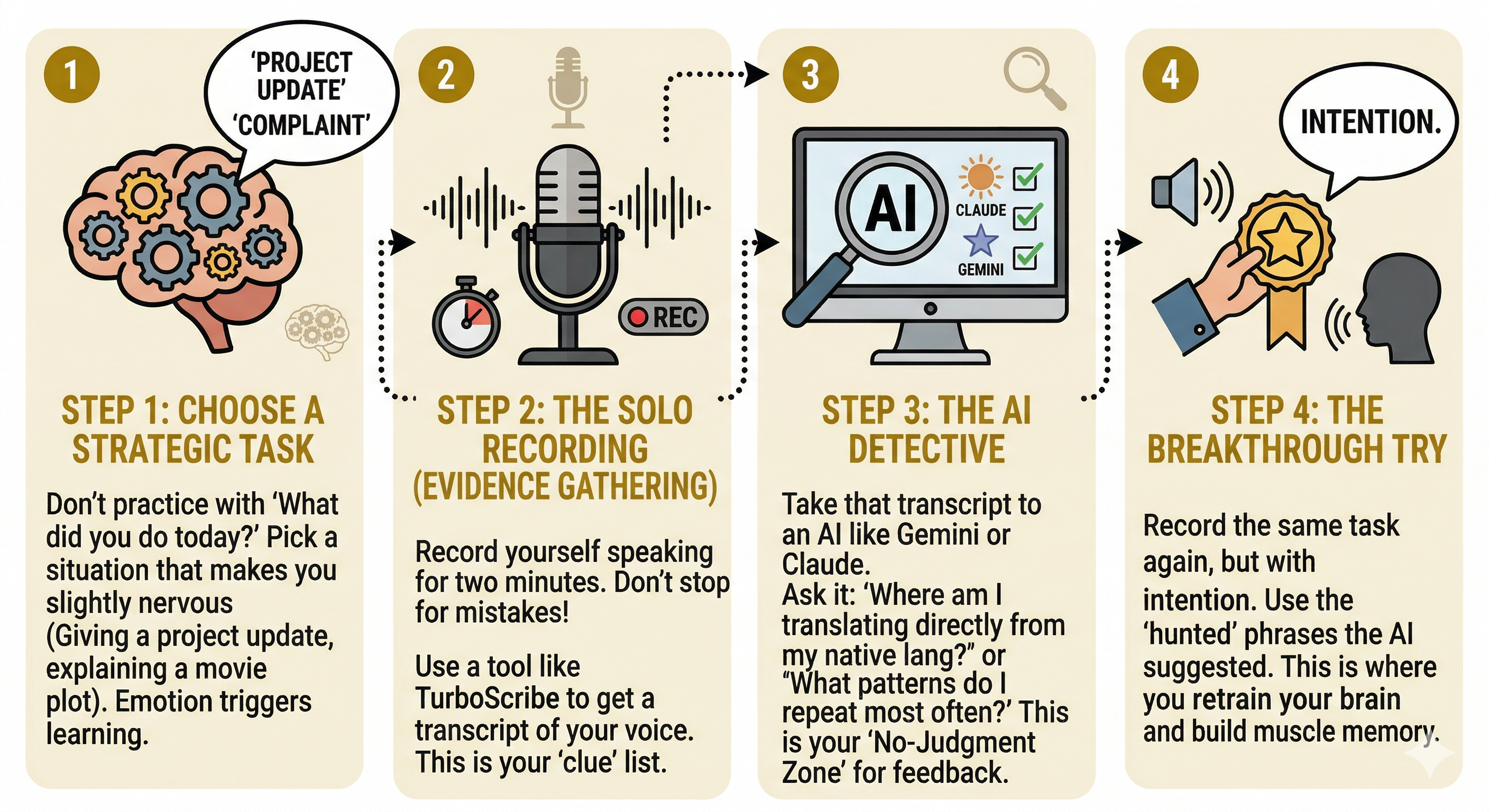
1. Choose a Strategic Task
Don't practice with "What did you do today?" Pick a situation that makes you slightly nervous. Giving a project update, explaining a complex movie plot, or handling a travel complaint. Emotion triggers learning.
2. The Solo Recording (Evidence Gathering)
Record yourself speaking for two minutes. Don't stop for mistakes! Use a tool like TurboScribe to get a transcript of your voice. This is your "clue" list.
3. The AI Detective
Take that transcript to an AI like Gemini or Claude. Ask it: "Where am I translating directly from my native language?" or "What patterns do I repeat most often?" This is your "No-Judgment Zone" for feedback.
4. The Breakthrough Try
Record the same task again, but with intention. Use the "hunted" phrases the AI suggested. This is where you retrain your brain and build muscle memory.
The "Shopping" Metaphor: Building Your English Wardrobe
Think of English vocabulary like a shop. You shouldn't try to wear everything in the store! If an expression doesn't fit your personality, leave it on the shelf.
In our recent story about Marc in Bangkok, he uses the phrase "a steep learning curve."
The Detective notices that this phrase feels professional yet energetic.
The Adult Learner asks: "Is this a 'me' phrase?" If it fits your life, hunt it. If not, ignore it. This is how you stop being a student and start being a human being again.
The “Fitting Room”: Retraining Your Brain with Zero Judgment
But here is the truth about shopping: you don’t just buy the clothes and put them in your cupboard, right? You have to go into the Fitting Room. You have to see how they feel on your body.
In English, your 'Fitting Room' is a safe place to practice before the real conversation starts. This is why I included the AI Speaking Partner prompt in your Story Immersion Journal.
Instead of feeling nervous about a real-time conversation, I want you to take that expression you 'hunted'—maybe it’s 'a steep learning curve' or something else Marc said—and 'try it on' with the AI.
Don’t try to be perfect. Be messy! Tell the AI: 'Hey, I'm Marc's friend. I also feel like I'm on a steep learning curve with my new job.' See how the words feel in your mouth. You are building muscle memory so that when you finally step out into that dinner party, you aren't thinking about grammar—you’re just wearing your favorite outfit.
The Result: Sounding Like YOU Again
Imagine walking into that next dinner party. Someone asks you how work is going.
Instead of a one-line answer, and instead of a long, slow translation that kills the vibe, you reach for that piece of 'clothing' you chose. You say: 'Honestly, it’s been a bit of a steep learning curve lately, but I’m really enjoying the challenge.'
It’s fast. It’s natural. And most importantly, it sounds like you.
You’ve moved from just understanding the language to actually living it. You aren’t just a student anymore; you are a commander of your English.
💬 What's next?
If you are tired of being 'Beige' and you’re ready to start building your own English wardrobe, here are some next steps:
📘 Download the free Story Immersion Journal:
Go to Page 3, pick your first story, start your first 'Hunt,' and remember: don't buy everything! Only keep what fits. 👉https://www.englishontherun.net/storyguide
🏰 Join The English Social Club: If you want to practice 'wearing' your English with a supportive group of smart adults who understand you, come and join us. We don't do classrooms here; we do connection. 👉english-social-club-uk-30qyzs3.gamma.site
Keep listening!
Subscribe to The English Social Club on YouTube.
Or the Natural English Podcast on Spotify.
Frequently Asked Questions about the Intermediate English Plateau
Q: What is the "Intermediate English Plateau" and why am I stuck? A: The intermediate plateau is the stage where you have enough grammar and vocabulary to "survive," but you stop seeing rapid progress. You feel like a "broken record" because your brain has defaulted to safe, repetitive patterns. Breaking it requires Deep Work—shifting from passive learning to active awareness of your speaking habits.
Q: How can I stop translating from my native language to English in my head? A: Translation happens when you try to find the English equivalent of a native thought. To stop this, you must switch from being a "Translator" to a "Detective." Instead of building a bridge from your native language, "hunt" for natural Social English expressions in stories and immersion that match your personality and use them as ready-made "blocks" of speech.
Q: Can AI (like Gemini or Claude) actually help me improve my English fluency? A: Yes, but only if used as a feedback tool, not a crutch. By transcribing your own voice and asking an AI to act as a "Detective," you can identify specific "translation traps" and repetitive errors that a human teacher might miss in a fast-paced conversation. It provides a no-judgment "Fitting Room" to practice before real-world performance.
Q: Is "Social English" different from the English I learned in school? A: Absolutely. Textbook English focuses on rules and "correctness," which often results in sounding robotic or "Beige." Social English is about connection, nuance, and identity. It’s the difference between saying "I am fine, thank you" and saying "Honestly, it’s been a bit of a steep learning curve, but I’m getting there."

Take your child's english to the next level


@ Copyright 2026
English on the Run| All rights reserved